Bathrooms company website and automation build
A build we are in the middle of right now, for a bathroom company in Manchester. Every feature of the site, page by page, and the system that goes in behind it.

Written by Tom Riley, founder of Growth Bull
12 min read Prices checked October 2026
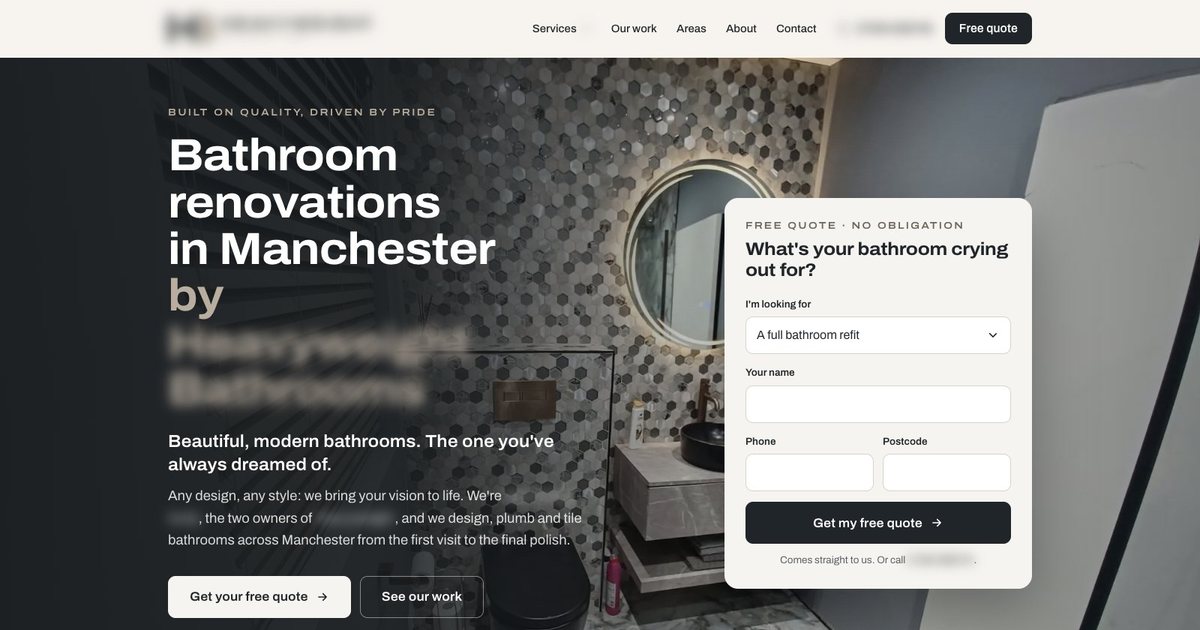
This is a build we are in the middle of right now, for a bathroom company in Manchester. The pictures and clips are from the build, with the company's name and logo blurred, and the site is not linked because it is not finished yet.
Every Growth Bull site has the same bones. What changes is the trade, the towns and the photos. Here is every feature of this one, page by page, and the system that goes in behind it.
What we proposed
A bathroom company with great work and nothing online to show it: no website, no Facebook Page, no Google listing. This is what we proposed on the first call, because the website is only the half of it.
- A website built up front, 22 pages, mobile first, with their real bathrooms and a quote form in the first screen
- A page for every service and every town they cover, written properly, so they show up when someone searches the job and the town
- A Facebook Page set up from scratch, with branded video reels cut from their jobs
- Their Google Business Profile set up, optimised and tied to the website, so they show on the map
- Professional branded email addresses on their own domain, so quotes do not come from a hotmail
- A local number on the site with missed-call text back, so a call they cannot take mid-job still comes back to them
- A simple leads dashboard: every form and every call in one list, with one tap to mark a job done
- Reviews on autopilot: every finished bathroom becomes a Google review request under their own name
- QuoteConvert: every quote as a branded page with one tap to accept
- Changes done for them every month: new photos, a new service, a new town, no chasing a web designer
- QR codes and printed review cards, so every finished job can ask for a review on the spot
- A run-through call once it is all live, so they know exactly what happens when the phone rings
How it works: five days from the first call
The process is the same for every trade, and it is built so the owner does as little as possible. Two calls, three days of building in between, and they are live.
- Day one, the discovery call: Tom rings for twenty minutes to learn the services, the towns they cover, the jobs they want more of, and what photos they have. That is all the homework there is
- Days one to three, the build: the website, the Facebook Page, the Google listing, the local number, the dashboard and the review automation are all set up while they get on with their jobs. They send photos over on WhatsApp as they come
- Day five, the onboarding call: they bring their customer list. It goes into the system on the call and the first review requests go out there and then. They get their QR codes and printed review cards for the van and the job sheet. Then we run through everything live, the dashboard, the review automation, missed-call text back, QuoteConvert and their Google page, so nothing is a mystery
- After that: new photos, a new service or a new town, done for them each month. Tom is a message away
The first thing people see
A big, honest photo of real work, the firm's name, the area it covers, and a quote form in the first screen. No stock photos. Someone with a tired bathroom and a phone in their hand gets what they came for in the first second: who you are, where you work, and how to get a price.
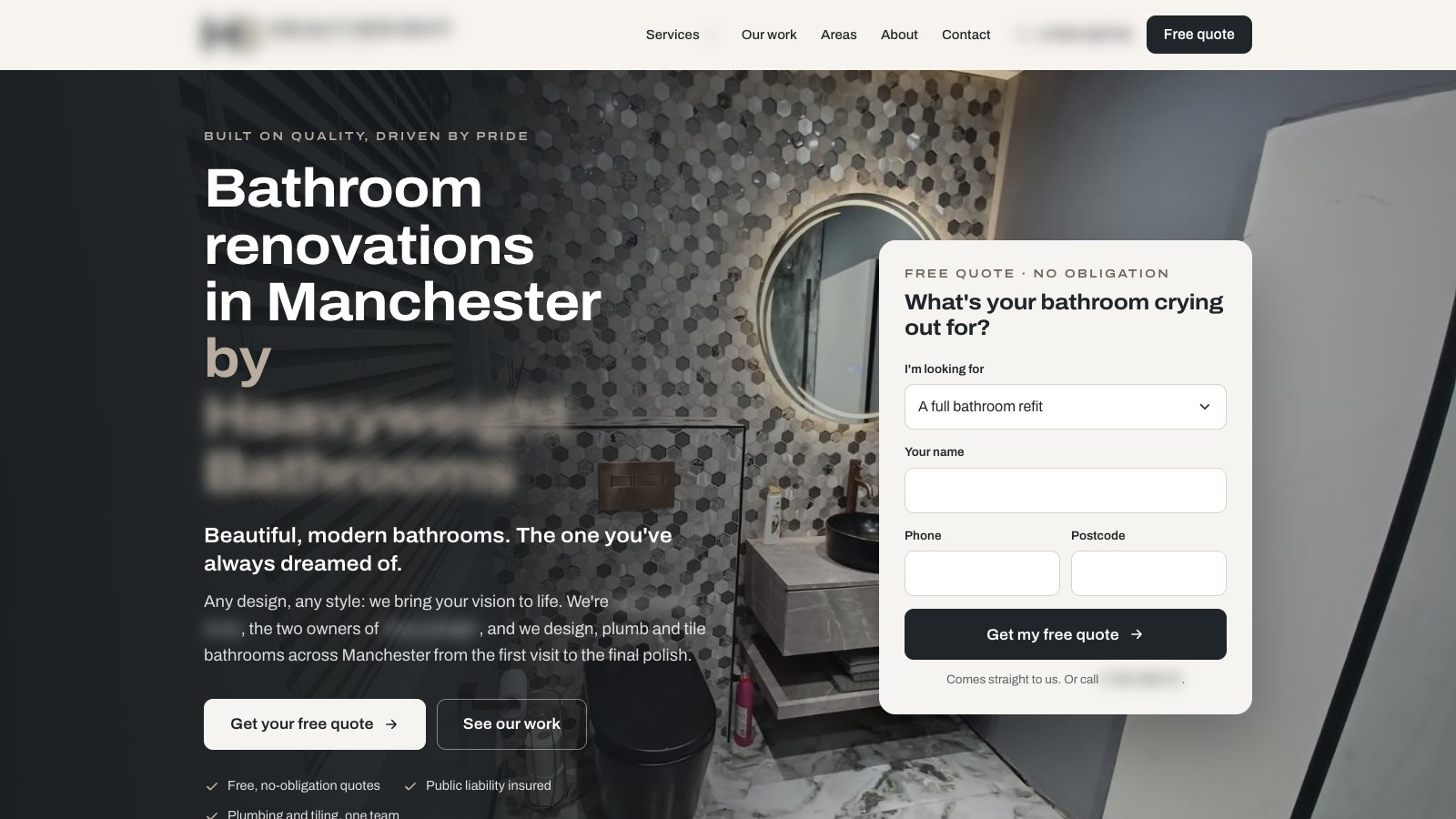
Have a scroll
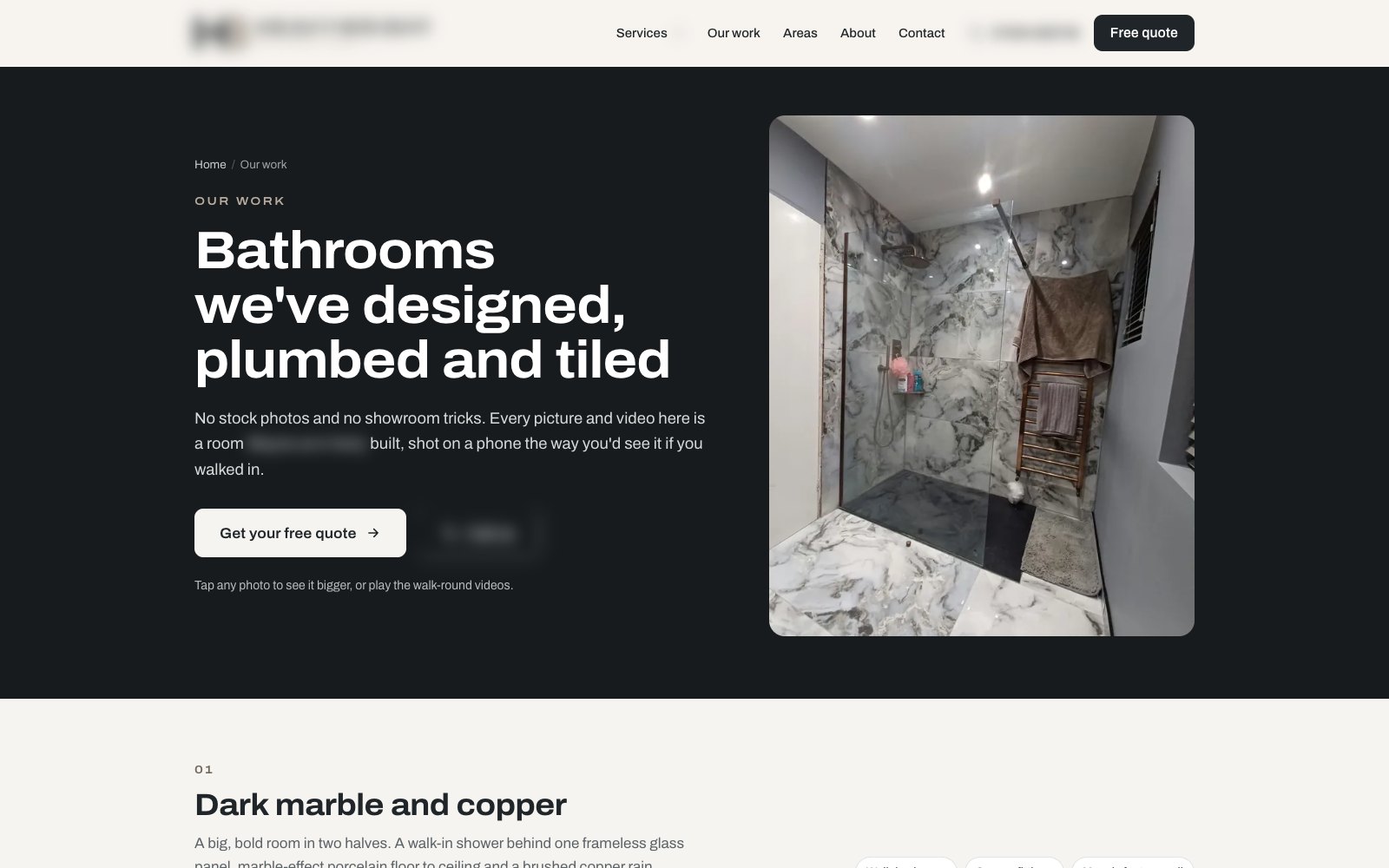
Their real bathrooms lead the page, not stock photos, so a homeowner sees the standard of work before they read a word. Under the first screen: the four reasons to trust them, a strip of the work, then every job laid out room by room with what was fitted and the photos.
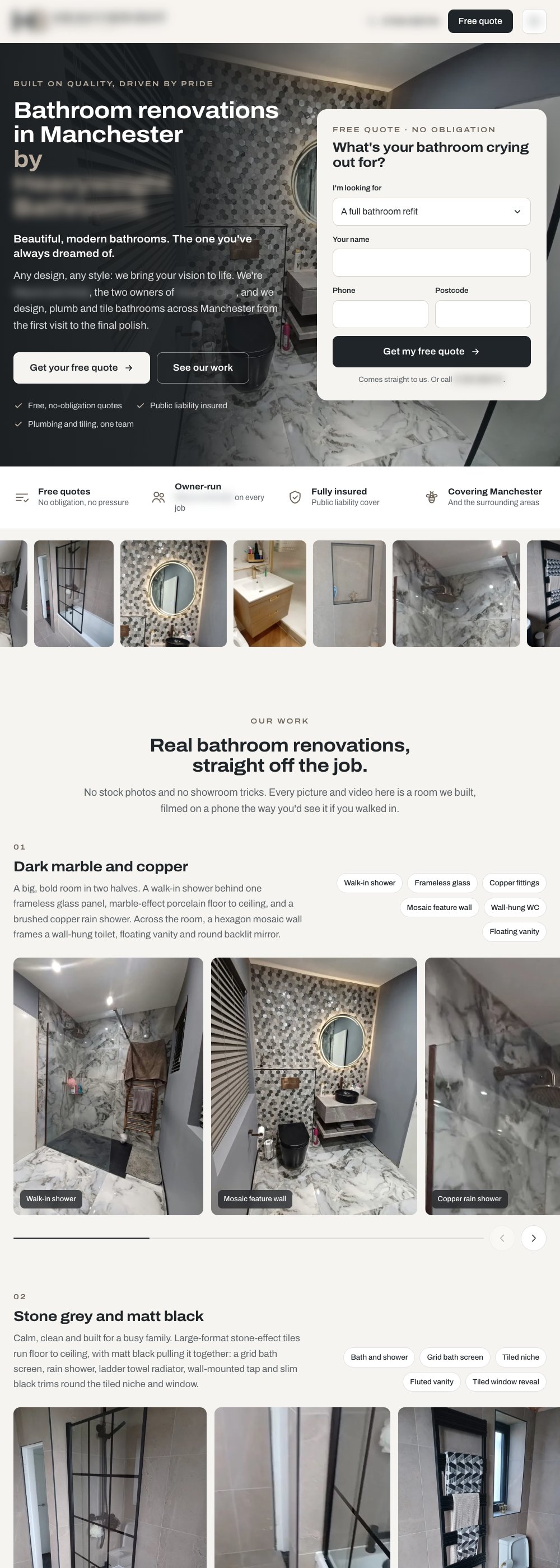
Built for the phone first
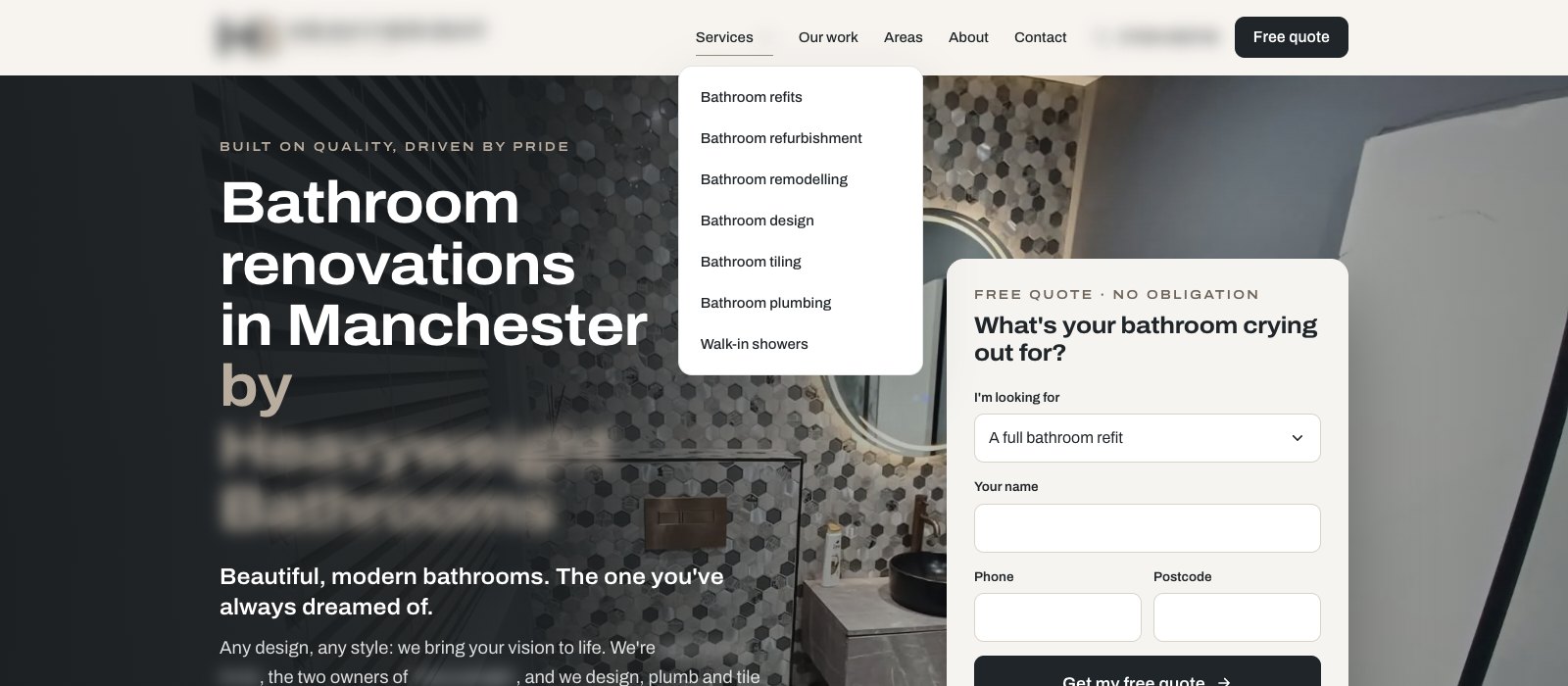
Most homeowners find a bathroom fitter on their phone, so that is where we started. Big photos, thumb-sized buttons, and a Call, WhatsApp and Free quote bar pinned to the bottom of the screen the whole way down, so anyone who likes what they see is one tap from ringing.
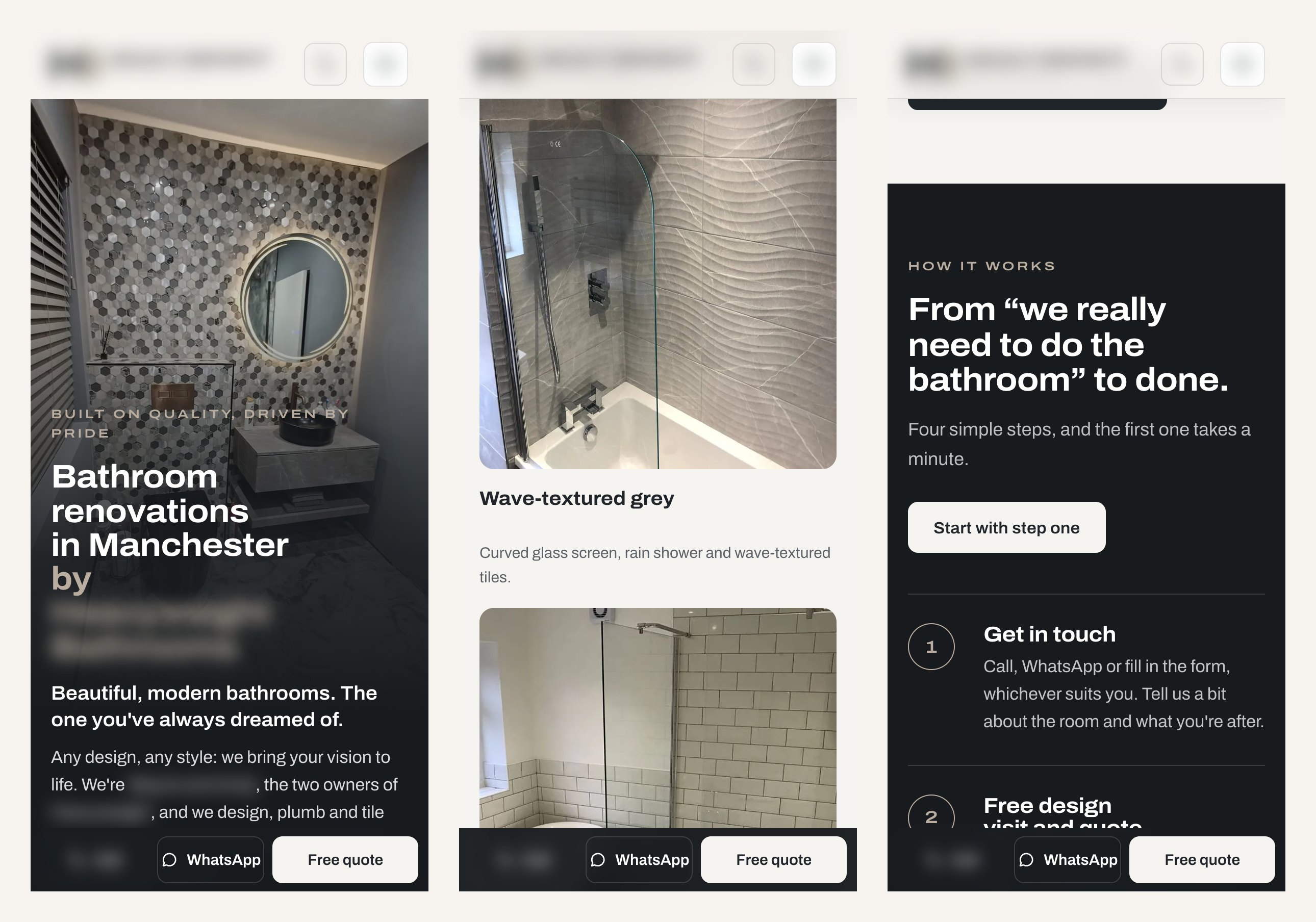
Every area on one map
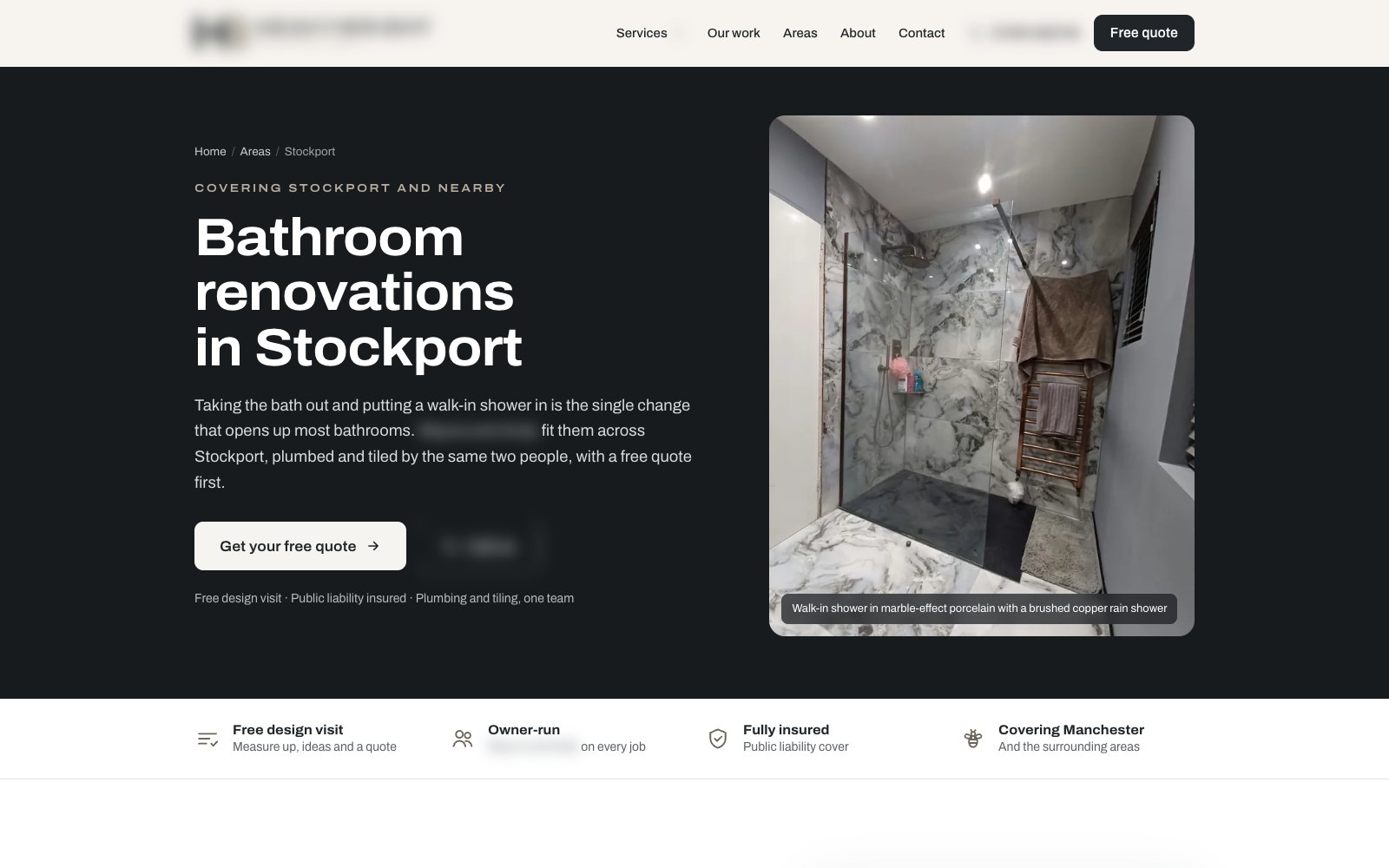
A map of Greater Manchester sits on the homepage and on every service page. Hover over a borough and it lights up, click it and you land on that town's own page. A homeowner in Stockport can see straight away that they are covered, instead of wondering and going back to Google.
Salford, Stockport, Trafford, Tameside, Oldham, Rochdale, Bury, Bolton and Wigan each get their own page, written for that town, so the business can show up in searches right across its patch.
The local pages: one real page per town
Each town page is a proper page, not a copy with the town name swapped. It carries the service and the town in the heading, the map with that borough lit up, the jobs done nearest to it, the questions people in that area ask, and a quote form. When someone in Stockport searches bathroom fitters Stockport, there is a page that answers exactly that, so Google has a reason to show it and the person has a reason to stay.
The benefit is simple: a firm that only has a Manchester homepage competes for one search. A firm with nine town pages competes for nine, and each one is easier to win because it is more specific than anything a national directory can offer.
22 pages, all linked together
More pages means more ways to be found. Each one targets something a homeowner actually types into Google.
- The homepage: the shop window, with the map, the work and the quote form
- Seven service pages: bathroom refits, refurbishment, remodelling, design, tiling, plumbing and walk-in showers
- Nine town pages, one for each borough around Manchester
- Our work: every job laid out bathroom by bathroom, with photos and walk-round videos. Proof beats promises
- About, Contact and Areas, plus a privacy page so the forms are above board
Taken straight from their logo
The colours come from the firm's logo: charcoal and a warm taupe, with plenty of clean space so the bathrooms do the talking. A site that looks this put together tells a homeowner the work will be too, which makes it easier to charge what the job is worth.
- Charcoal for the headings, the header and the buttons
- Warm taupe for the accents, lifted from the logo
- Warm white behind everything, so the photos carry the page
A call button right where your thumb is
A good-looking site that nobody rings from is a brochure. Every page is built to turn a look into an enquiry.
- Call, WhatsApp and Free quote pinned to the bottom of the screen on phones, right where your thumb already rests, the whole way down the page
- The quote form in the first screen, so nobody has to hunt for it. The fewer steps, the more people finish
- On computers, a header that stays put with the phone number and a Free quote button always in view
- A nudge after the photos: seen one you love? Let's design yours. It catches people at the moment they are most excited
- A free design visit offered on every page. A free first step is easy to say yes to
- Every form lands straight in the leads dashboard, and if a send ever fails it hands over to WhatsApp instead, so a lead is never lost
Headings, in the order Google reads them
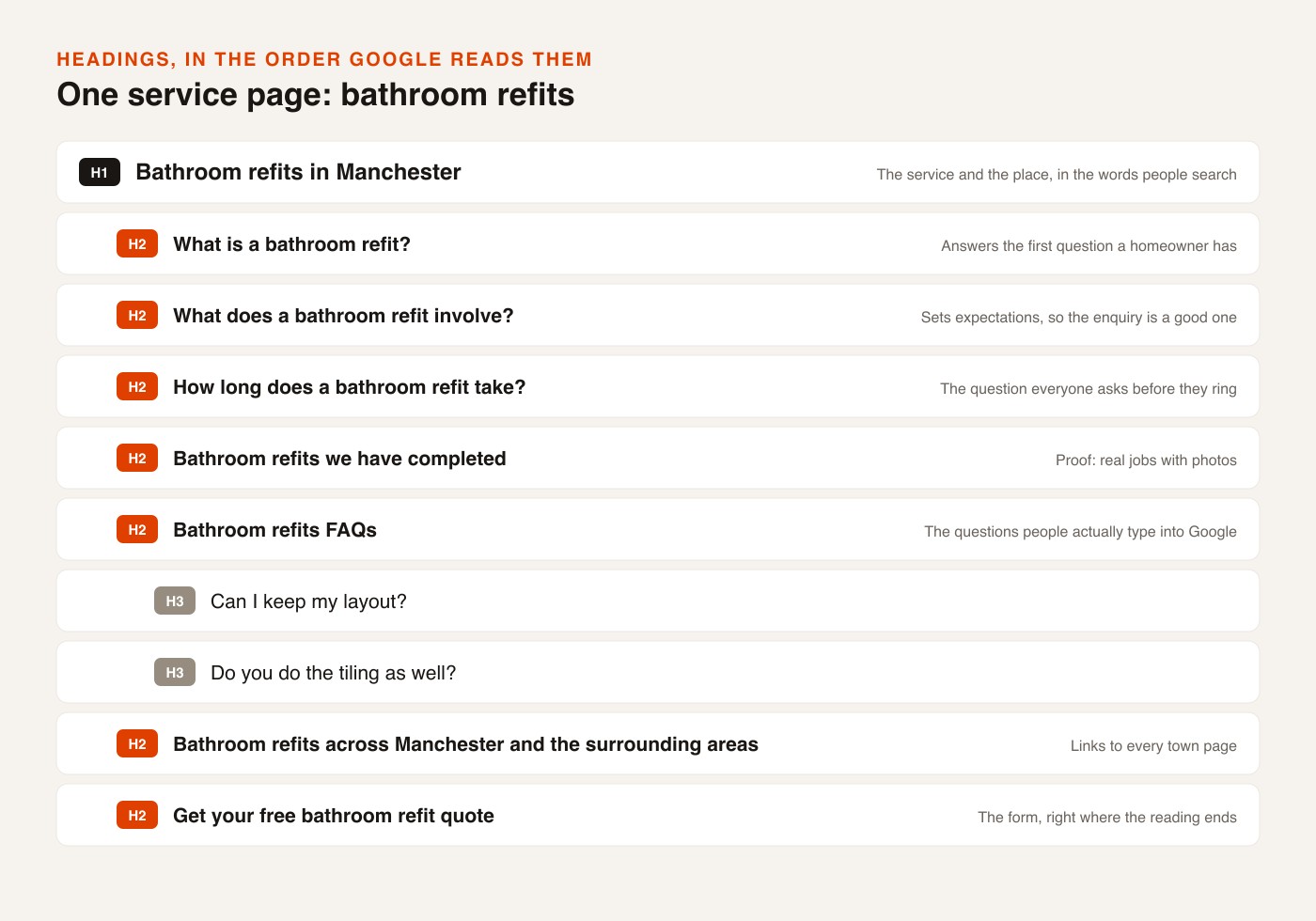
Google reads a page top down and uses the headings to work out what it is about and whether it answers the search. So every service page runs in the same order: the service and the place in the main heading, then what the job is, what it involves, how long it takes, the proof, the questions people ask, the areas covered, and the quote form where the reading ends. One heading per question, in the words people type.
The benefit: a page that answers the search in the order people ask it keeps the reader on the page and tells Google, without any tricks, that this is the page to show. Here is the bathroom refits page laid bare.
The entities Google picks up on
Google does not read a page like a person does. It looks for things it already knows about, the entities: the business, the services, the places, the questions, the reviews, the real jobs. The site names all of them plainly, in the words people search with, and the schema markup repeats them in code: LocalBusiness with the address and the areas served, a Service for every service page, FAQPage for the questions, BreadcrumbList for the structure, and the reviews as they come in.
The benefit: Google can connect bathroom refit, Stockport and this business without guessing. That is what gets a page into the map pack, and increasingly it is what gets a business named when someone asks an AI assistant who to call.
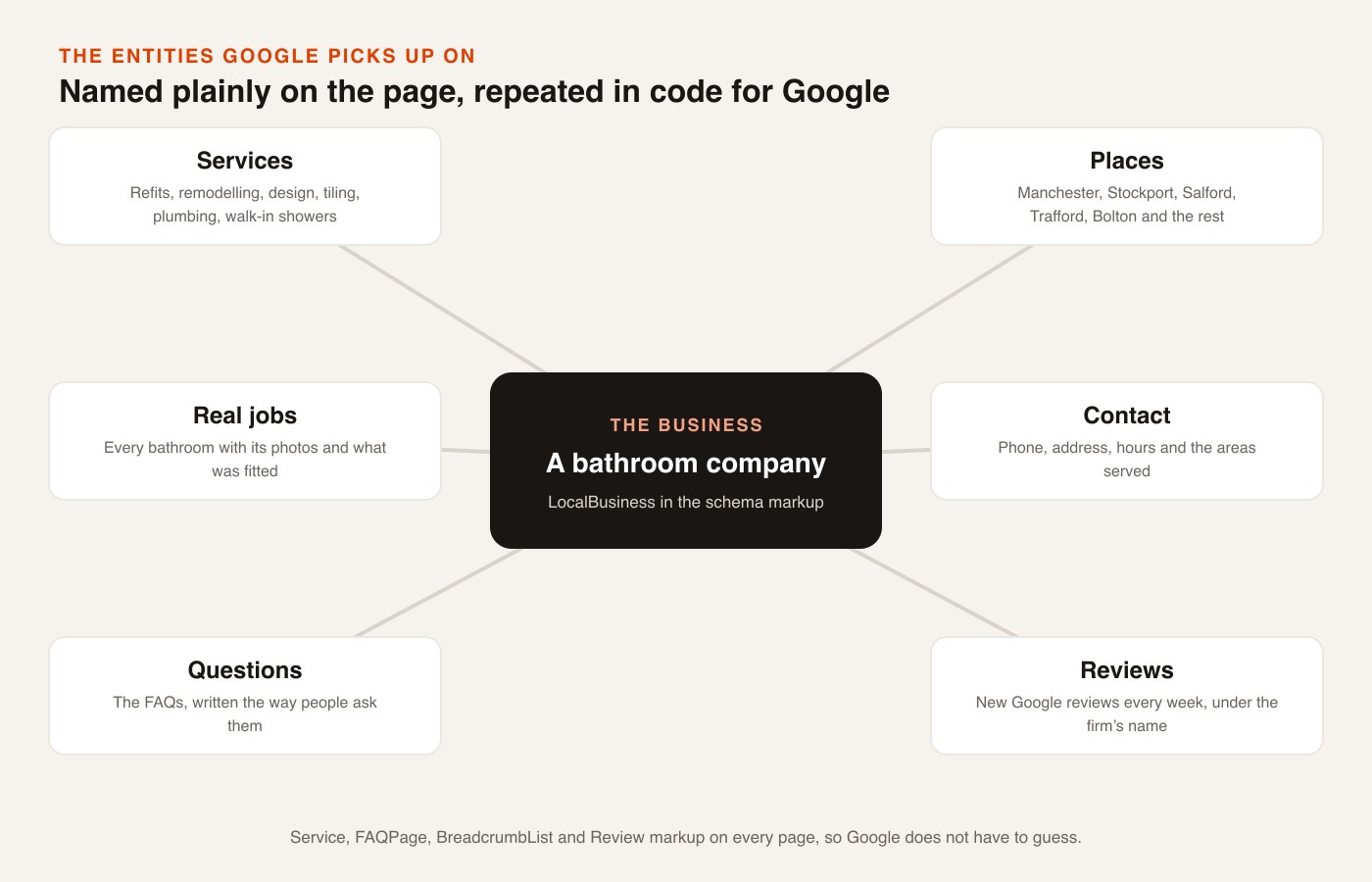
- Schema markup: hidden code on every page that spells out for Google what the business is, the services it offers, the areas it covers and the answers to common questions, so it can match the right page to the right search with confidence
- Internal links with the right words: bathroom tiling links to the tiling page, walk-in showers to the walk-in showers page, so every link tells Google what the page on the other end is about
- A page for every town, so they can show up when someone in Bolton or Stockport searches, not just Manchester
- Breadcrumbs at the top of every page, which show Google how the site fits together and help visitors find their way back
- Every photo described and every file sized to load fast. Slow sites lose visitors before the page has even appeared
A Facebook Page from scratch
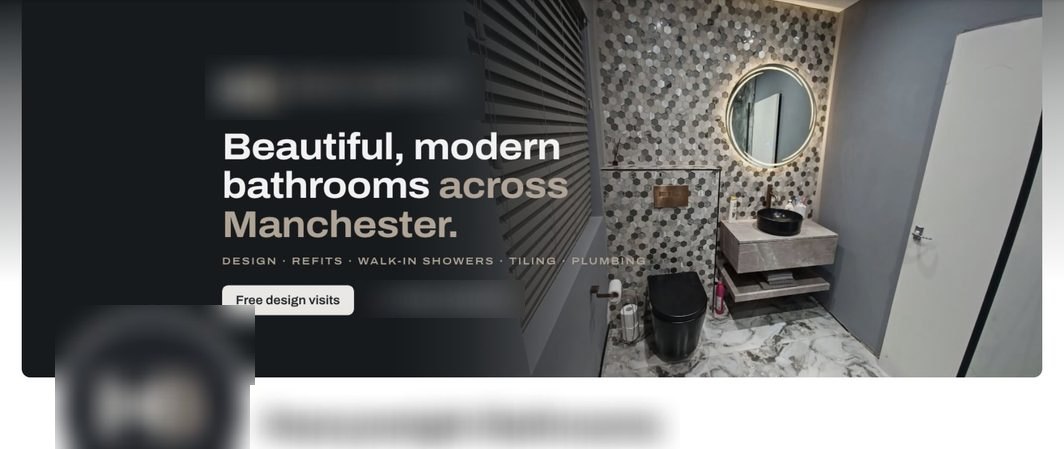
They did not have a Facebook Page, so we set one up: their logo, a cover showing their work with the number on it, and a Call button. When a homeowner checks them out on Facebook, there is a proper business there, not nothing.
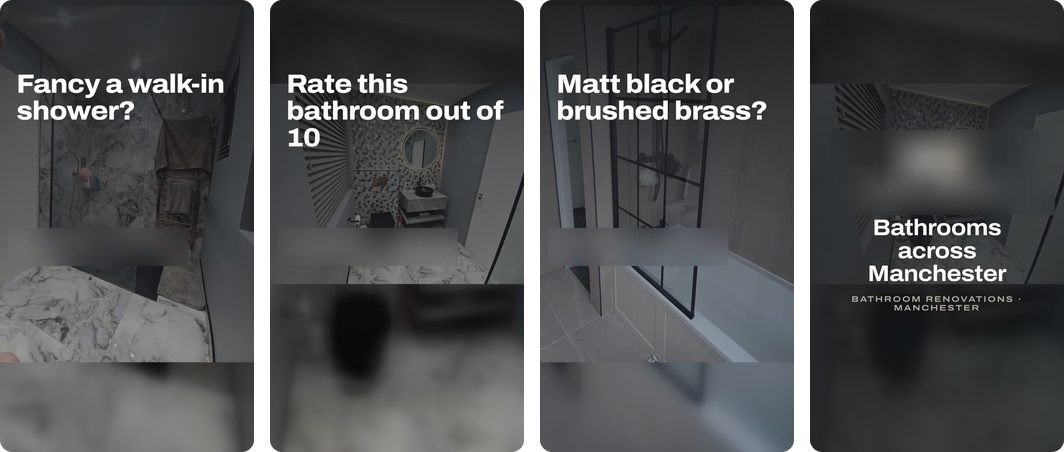
Then we cut branded video reels from their jobs, each with a different hook to stop people scrolling. Video gets shown to far more people than a plain photo post, and every reel ends with their number. The first ones are already on the Page, with more lined up.
The Google page, done properly
When someone in Manchester types bathroom fitter into Google, the first thing they see is the map with three businesses on it. Getting on that map is not luck. It is the Google Business Profile, set up and worked on, and it is the next thing to go in for this firm.
We set the profile up with the right categories and the real services, then make the services on the listing match the pages on the website, word for word. Google likes it when the two agree, and it is one of the strongest signals it uses to decide who goes on the map. The profile is embedded on the website too, which ties the two together. Then it is kept active: regular posts, the new jobs added as photos, and a steady run of new reviews landing on it every week.
- The right categories and every service listed, matching the website page for page
- The business address and area set so the map pin and the service area are right
- The listing embedded on the website, so Google sees the site and the profile as one business
- Regular posts and new job photos, so the listing never looks abandoned
- New reviews landing on it every week, from the review automation below
Reviews on autopilot, pushing the Google page up
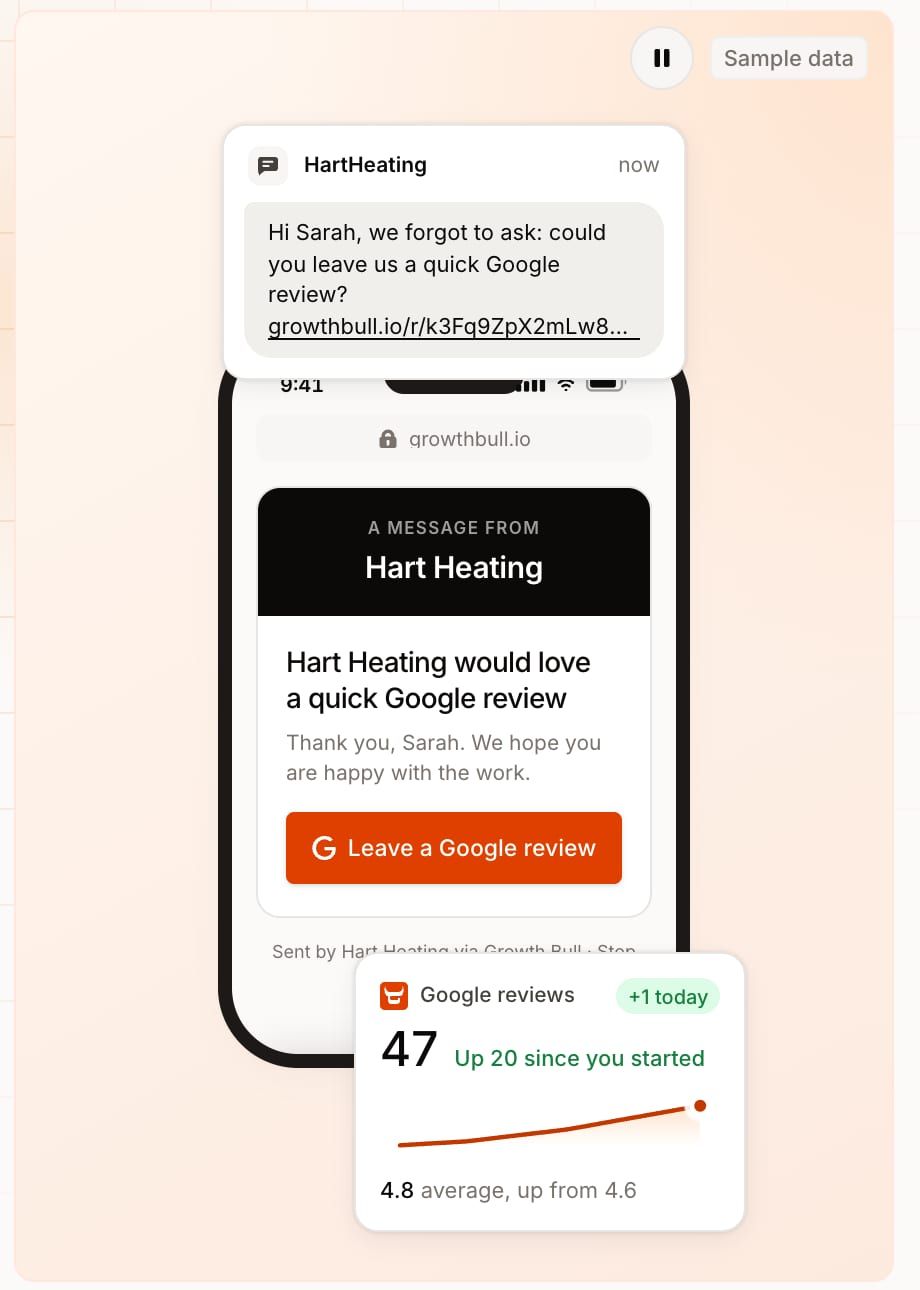
Reviews are the thing every trade knows they should ask for and nobody gets round to. So the system asks for them. When a bathroom is finished, the firm marks the job done in their dashboard, one tap, and the customer gets a friendly text under the firm's own name with one tap straight to the Google review form. Nothing to type, nothing to find.
Past customers get asked too, from the list of old jobs, a few a day so it never looks like a flood. For the jobs where the customer is stood right there, they get QR codes and printed review cards to leave behind: one scan and the customer is on the review form before the van has pulled off. A steady run of recent reviews is what moves a Google page up the map rankings, and the reviews then show on the website, where they win the next job. No review is ever filtered or hidden: everyone gets the same link, and only Google decides what shows.
The system behind the website
A good-looking site is only half of it. This is what goes in behind it, and it is the same for every client.
- A local number with missed-call text back: a Manchester number on the site and the adverts that rings straight through to their mobile. Miss a call mid-job and the caller gets a text from the firm within seconds, so they do not ring the next name on the list
- The leads dashboard: website enquiries and calls land in one list they log into. Mark a job done with one tap and the review request goes out on its own
- Reviews on autopilot: every finished bathroom becomes a review request, under the firm's own name, straight to the Google review form. A steady run of recent reviews moves the Google page up the rankings
- Professional branded email addresses on their own domain, set up for them, so a quote never arrives from a hotmail
- QuoteConvert: every quote becomes its own branded page with one tap to accept, and they see the moment it is opened. The customer gets a clean page on their phone instead of a PDF they cannot read, and the firm sees who has opened what
What it means for a trade business
- More enquiries from people already looking, because the site shows off the work and makes getting in touch easy
- Found across your whole area, with service and town pages built around what people actually search for
- No more lost jobs: missed calls get a text back, and every call and form is logged
- Less admin: who called, what they want and where they are, in one list
- More reviews, which win you more work the next time someone compares trades
- One look everywhere: website, Facebook and Google, all matching your brand